
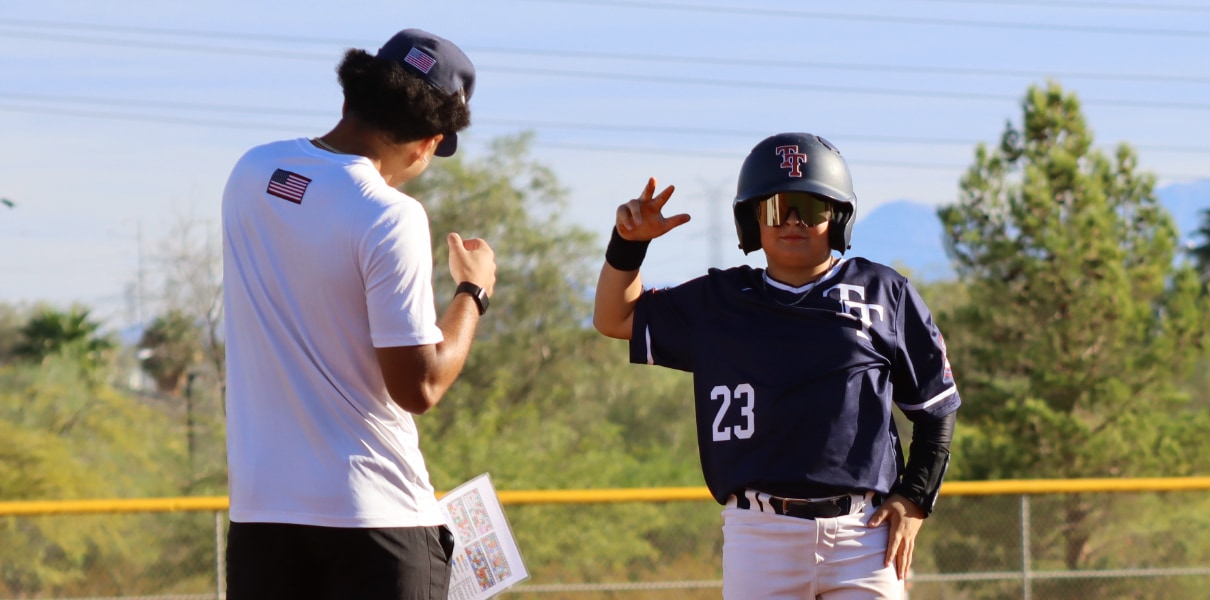
Nate Waskey didn’t set out to become a hitting coordinator. He set out to understand things — really understand them — and the title followed naturally.
Now serving as Hitting Coordinator for Top Tier Las Vegas, the UNLV student and newly certified NASM Performance Enhancement Specialist has quietly built a reputation as one of the more complete instructors working with youth athletes in the program.
His approach blends mechanical precision with mental performance training and a genuine focus on long-term health — not as three separate disciplines, but as one interconnected philosophy.
“I’ve always been super detail oriented,” Waskey explains. “I wanted to better understand how the body actually moves and performs — both physically and mentally.”
The NASM certification gave him a sharper lens for all three areas: building strength and power that translates to the field, reinforcing the mental habits that separate good hitters from great ones, and identifying movement imbalances before they become injuries.
That last piece is personal.
Waskey speaks with rare candor about a career-altering elbow injury he sustained as a player — one that reshaped how he thinks about development at every level.
“I wish I had prioritized my workload and taken better care of my body at a younger age,” he says. “Developing strength, mobility, and recovery habits early will be absolute game changers down the road.”
It’s not a talking point. It’s something he lived.

From NorCal to Las Vegas
Waskey came up through Top Tier’s Northern California organization, where he both played and coached — often working with athletes who had watched him compete. It was a close-knit environment built on existing relationships and shared history. Las Vegas was something different entirely.
“Moving to Las Vegas was a reset for me,” he says. “It pushed me out of my comfort zone and forced me to grow — not just as a coach, but in how I communicate and connect with players I didn’t already have a relationship with.” That transition, he believes, made him sharper. More intentional. Better at building trust from scratch rather than relying on familiarity.
It’s that intentionality that now defines his work as coordinator — a role he’s spent three years building toward. His vision for the hitting program is structured but individualized: a clear foundation of core principles that applies at every level, delivered in ways that actually meet the athlete where they are.
For younger players — the 10U crowd just learning what balance and timing feel like — that means simplification and athletic development. For the older high schoolers, it means deeper mechanical work, sharper approach, and a focus on self-sufficiency.
“As players get older, a big part of it is teaching them how to coach themselves,” Waskey says. “That’s the reality of baseball at higher levels — you don’t always have someone there to guide you in the moment. Giving them the tools and confidence to make their own adjustments is a major focus for me.”

Technology as a Tool
Waskey is comfortable with the modern toolkit — video review, bat sensors, Blast and Rapsodo data — but clear-eyed about its proper role.
“I use technology to give players feedback and help them understand the difference between what they feel and what’s actually happening,” he says.
For a lot of athletes, seeing their mechanics alongside a data readout closes the gap between intent and execution faster than words alone.
But he’s careful not to let the technology become a dependency. The goal, always, is to build awareness that eventually lives in the body — feel and performance that shows up in games, not just in the cage.
That same grounded perspective extends to the broader debates swirling through the hitting instruction world. Waskey has little patience for dogma. “I don’t believe in a one-size-fits-all approach,” he says.
Every hitter moves differently. Every athlete has a different mental makeup. Clean, efficient mechanics matter enormously — but so does the competitive mindset behind them.
“You can have great mechanics, but if your mindset isn’t in the right place, it’s going to affect your performance. When you combine efficient movement with a confident and competitive mindset, that’s when hitters really start to separate themselves.”
What’s Being Built at Top Tier Las Vegas
Waskey is direct when asked about the state of youth baseball today. He sees real positives — stronger competition, faster athletes, more resources than any previous generation. But he’s troubled by what he calls a shortcuts mentality, a culture so focused on early exposure and early commitments that fundamental skill development gets shortchanged in the rush.
“The players that focus and take the time to build skills and consistency are the ones who thrive long term,” he says. It’s the kind of thing coaches say all the time — but Waskey has the lived experience to back it up, and he’s helping to build a program around proving it.
At Top Tier Las Vegas, that means a development-first culture where every decision has a purpose behind it, and where the coaching staff is expected to keep growing alongside their athletes.
“We prioritize relationships, accountability, and long-term growth,” Waskey says. “It’s not just about short-term results — it’s about helping players become well-rounded, confident athletes who can perform consistently on and off the field.”
For a coach still early in his career, it’s a clear-eyed vision. And if the last three years are any indication, he’s just getting started.
Leave a Reply