
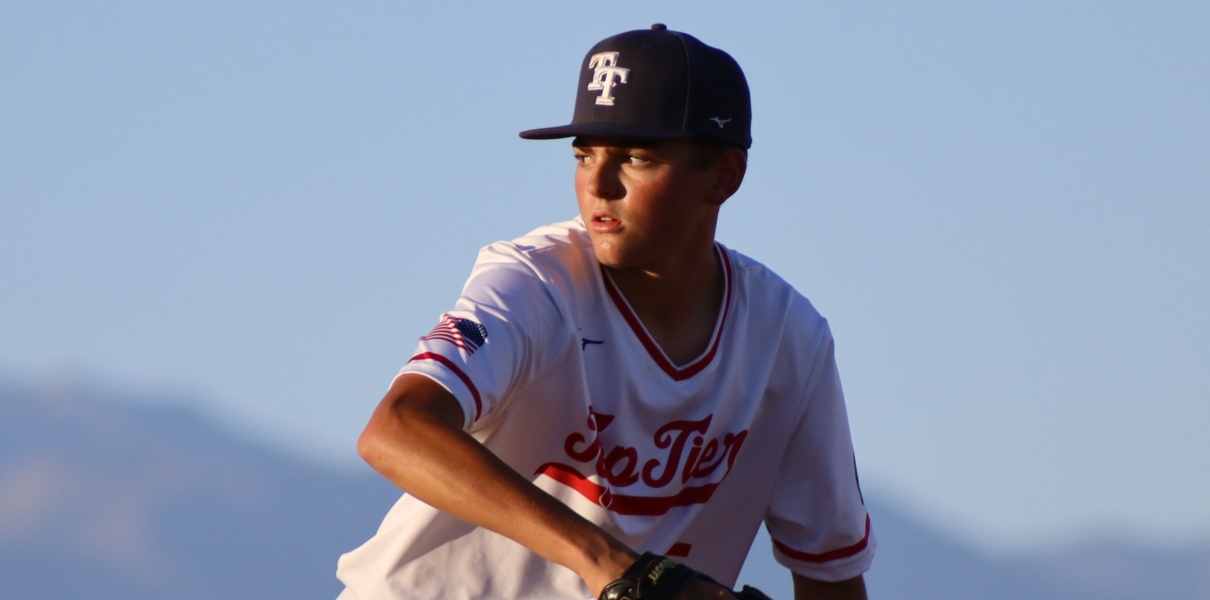
Ty Kincaid is 6’4″, sitting 84 miles per hour with his fastball, and according to the people tracking him most closely, he’s supposed to grow another three to four inches.
Let that land for a second.
The Palo Verde sophomore is already the top-ranked left-handed pitcher in Nevada’s Class of 2028 according to Prep Baseball Report. He throws four pitches, works in the zone consistently, and moved across the country this past summer from Kansas to Las Vegas without missing a developmental beat. And by most accounts, the best version of Ty Kincaid hasn’t come close to showing up yet.
“He’s 6’4″ now, and just really learning how to use his body properly,” says Top Tier Las Vegas Director Patrick Flowers “That’s going to be the biggest unlock for him — in a year when he’s flirting with 6’7″ and he’s going to be in the 90s with his fastball from the left side and a three-pitch mix. Ty’s talking about playing D1 baseball, but if everything shakes out the way we want it to, we’re going to be talking more than that.”
Brett Harrison, Mountain West Supervisor at Prep Baseball Report, has been watching Kincaid closely. His assessment is concise and telling. “It’s pretty impressive — being 6’4″ with the velocity still to come. The delivery is consistent and low-effort. He’s not straining and reaching back for velocity. He lives in the zone. He understands his game.”
That last part — he understands his game — is the thread that runs through everything Kincaid does on the mound.

Four Pitches, One Focus
Ask Kincaid what his best stuff has looked like this spring and the answer is revealing for what it doesn’t say as much as what it does. There’s no talk of overpowering hitters. No emphasis on the radar gun. The answer is about execution, location, and trust.
“I’ve been successful when I stay in the zone and locate all four of my pitches,” he says. “I know my pitches have plenty of movement. I trust that good things will happen if I can throw strikes with multiple pitches.”
Those four pitches include a fastball, a changeup he already throws with genuine feel, and a cutter he’s been developing this spring with Top Tier coaches Gavyn Bowen and Patrick Flowers. “My cutter has been really effective and it’s a new pitch I’m still developing,” he says. The fact that a 15-year-old is adding a cutter to an already functional arsenal — and doing it successfully — speaks to both his aptitude and the environment around him.
The long-term goal is straightforward: get the fastball from the mid-80s to the mid-90s. “I’m going to work like crazy to get my velocity there,” he says. “My goal is to play college baseball at the highest level, so I need to continue to get stronger and improve my mechanics.”
When you factor in the projection — a frame that may not be done growing for another few years — the math on that velocity jump is not far-fetched. It’s expected.
The Adjustment: Mounds, Heat, and a New Role
Moving from Kansas to Las Vegas in the middle of a development year isn’t a small thing, and Ty Kincaid is candid about the adjustments that came with it. Some were environmental. “The dirt on the mounds here is more loose,” he notes, “and it took some time to get used to the dry heat as well.” Others were competitive. “The level of baseball where I lived in Kansas was not as high as Vegas. There are more talented players here and I am learning a lot.”
The biggest on-field adjustment this spring, though, has had less to do with geography and more to do with role. Kincaid is accustomed to being a starter — mentally prepared, routine established, focus locked in from the moment he knows he’s going. At Palo Verde, one of the deepest pitching programs in 5A, his role so far has been out of the bullpen.
“It has been challenging to not have time to mentally prepare for a start,” he acknowledges. But his response to that challenge says something about his makeup. “Coming out of the bullpen has been good for me. I’ve enjoyed the intensity and pressure that comes with pitching later in games as a reliever.” A pitcher who can recognize the value in a role that isn’t his preference — and genuinely embrace it — tends to find his way to more innings, not fewer.

His two cleanest outings this spring have produced 1 run allowed and 8 strikeouts against just 2 walks, a line that reflects the zone-attack mentality Harrison identified. The outlier start — where five runs crossed in a hurry — is more footnote than indicator for a pitcher whose stuff and approach are both trending in the right direction.
Top Tier and the Family Piece
When Ty Kincaid arrived in Las Vegas last summer, finding the right development environment quickly mattered. He found Top Tier Las Vegas, and what drew him wasn’t a sales pitch about velocity gains or showcase exposure. It was something simpler.
“I really liked the family aspect of the program,” he says. “Everyone supports each other and wants to bring out the best in each other. I’m really thankful to have coaches and teammates that believe in me and want to help me reach my goals.”
The work inside that environment has been specific and intentional. The current focus is mechanical — using his lower body more effectively and increasing hip-shoulder separation. For a pitcher with Kincaid’s frame and projection, those two things are directly connected to the velocity jump he’s chasing. Getting a tall, long-limbed pitcher to load and drive efficiently is one of the more complex development challenges in the sport, and it’s the central project between Kincaid and the Top Tier player development staff right now.
“That’s going to be the biggest unlock for him,” Flowers said. The frame is there. The feel is there. The work is ongoing.

Cary, North Carolina, and What Comes Next
This summer Kincaid won’t just be on the showcase circuit with the Top Tier Las Vegas 16U Americans team — he’ll be representing Top Tier on the Select national team at the USA Baseball National Team Championships at USA Baseball’s National Training Complex in Cary, North Carolina. For a sophomore pitcher still learning his craft and still growing into his body, the opportunity to compete at that level on a national stage is significant.
His approach to it is characteristic. “It is an honor to play for the national team and I will do my best to represent Top Tier Vegas in the best way.” No overthinking. No performance anxiety. Just compete.
That same composure carries into how he thinks about college coaches watching him this summer. “I don’t feel any pressure. I’m confident that if I execute my pitches, that will be good enough to get outs and be successful. When I’m on the mound, I’m only thinking about the next pitch and focusing on what I can control to help my team.”
What he wants those coaches to walk away with is equally clear. “I want them to think that I’m competitive and mentally tough on the mound. I also want them to see that I love the game of baseball and will do anything to help my team.” For a pitcher whose stuff is still developing, leading with competitiveness and makeup is exactly the right thing to put in front of college programs at this stage.
The dream destination is programs like UCLA, Oregon, or Stanford. The coaching staff around him believes the ceiling is high enough to warrant that conversation. Brett Harrison at Prep Baseball Report is already watching closely enough to rank him first in his class in the state. And Kincaid himself is locked in on the work — bigger, stronger, more efficient, and eventually throwing harder from a frame that may not stop growing for years.
He’s 6’4″ and sitting 84. He’s a sophomore. And he’s just getting started.

Leave a Reply