
We have a problem in youth baseball.
Yes, I know — there are plenty of things that could fit in that bucket. Cost. Overuse. Burnout. Early specialization. Pick your poison.
But the one I want to talk about today is simpler, and in many ways more alarming:
Kids aren’t watching high-level baseball anymore.
When I say “high-level,” I mean professional and collegiate baseball. MLB. The College World Series. Friday night SEC games. Regional baseball. Not travel ball highlights. Not Instagram clips. Not YouTube edits of 12U tournaments.
Those things have their place. But when that becomes the highest level of baseball players are consuming, we have a real issue.
I recently had a player tell me he had never seen Tarik Skubal pitch. Didn’t recognize the name. Didn’t know who he was when I brought him up.
We’re talking about a back-to-back American League Cy Young Award winner.
That wasn’t a one-off. It’s a pattern.
And if that doesn’t set off alarm bells, it should.
This Isn’t New — But It’s Never Been This Bad
Before anyone labels this an “old man yelling at clouds” moment, let me be clear: this isn’t new. Every generation complains about the next one. That’s nothing groundbreaking.
What is new is the scale.
When I was growing up, every kid on the field had a favorite player. You wore his jersey. You had his baseball card. You mimicked his stance, his leg kick, his arm slot — until a coach eventually told you, “That works for him, not for you.”
Ironically, player development is far better now. We understand movement efficiency, biomechanics, and individuality in ways we never did. Stances and deliveries are no longer copy-and-paste, and that’s a good thing.
But here’s the tradeoff.
As development has evolved, the desire to actually watch the game has eroded.
When I first started coaching 15 years ago, players still followed pro and college baseball. Even as imitation shifted away from mechanics, the influence was still there. Players adopted styles. Swagger. Demeanor. The way guys carried themselves between pitches. The way they competed.
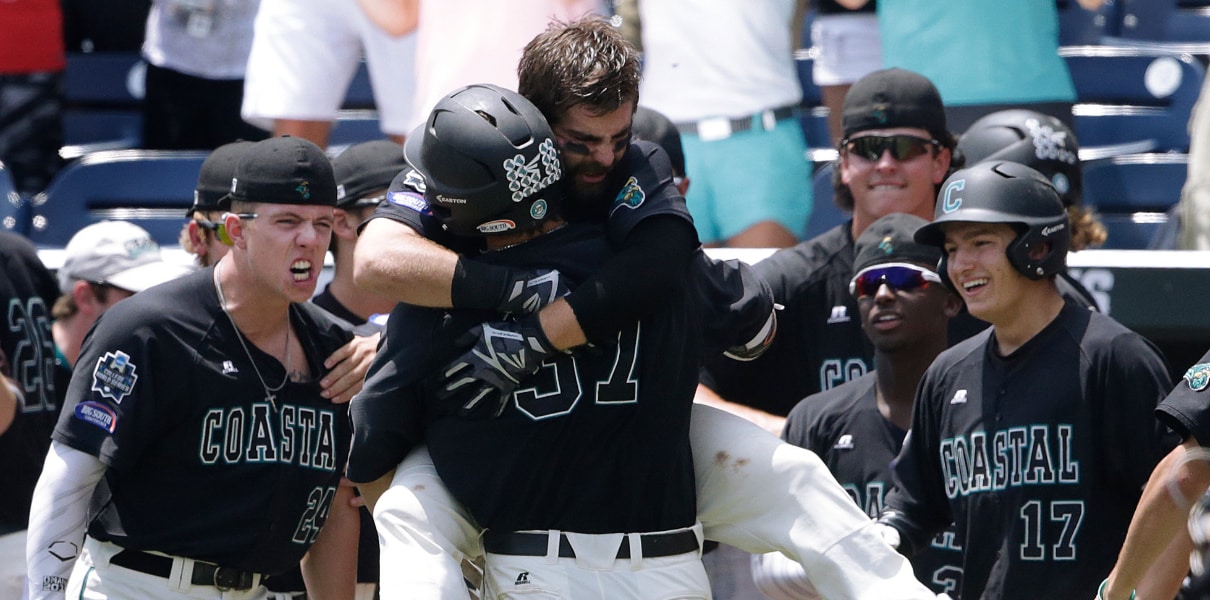
I remember coaching at the Omaha SlumpBuster in 2016. Our entire 16U team packed into Charles Schwab Field — standing room only — to watch Coastal Carolina beat Arizona in the College World Series. Seats didn’t matter. Phones didn’t matter. TikToks weren’t being made. The kids were locked in.
They watched Pete Alonso hit tanks for Florida before he ever did it in Queens for the Mets or on a national stage at the Major League Baseball Home Run Derby.
That connection mattered.
Somewhere Along the Way, the Script Flipped
Fast forward to now.
This summer, I sat in a hotel lobby in Arizona with two high school players watching the College World Series. The rest of the team had no interest.
This fall, we took 25 players to a UNLV–USC baseball game — in their own backyard, on a perfect day. I had a player fall asleep. Others were trying to DoorDash food to the stadium.
This isn’t about calling kids out. But if the shoe fits, you get the point.
Here’s the reality:
The players who live the game — who watch it, study it, and care deeply about it — are now the minority.
A decade ago, there were a handful of kids on each team disconnected from the pro and college game. Now it’s the opposite. There are only a few in each dugout who truly consume it.
Why This Actually Matters
This isn’t a “love of the game” debate. The kids in our program love baseball. They work. They show up. They compete.
This is a development problem, and it’s two-pronged.
First: Baseball IQ.
Watching high-level baseball makes players smarter. It builds context. It sharpens instincts. It gives coaches reference points that mean something to the athlete. When players don’t watch the game, every concept feels abstract. Every adjustment feels foreign.
Second — and more dangerous — perception.
The perception of what good actually looks like.
When players aren’t exposed to elite baseball, they lose their ability to accurately evaluate talent — including their own. The gap between good, average, and elite gets blurred. That’s how we end up in an environment where players (and parents) genuinely believe they’re much closer to the next level than they are.
And when you think you’ve already arrived, you stop chasing growth.
This is where frustration creeps in. The “why isn’t it me?” conversations. The palms-up body language. The belief that opportunity — not performance — is the problem.
My philosophy has always been simple:
If you want someone’s job, take it.
The prerequisite is that you have to be better than them. And that usually requires outworking them.
But that urgency disappears when players don’t truly understand how high the bar actually is.
Exposure Shapes Standards
This isn’t about gatekeeping. Club baseball access has expanded, and that’s not inherently bad. Players deserve access to good coaching. Coaches deserve opportunities to teach and develop.
But access without perspective creates entitlement.
When players don’t regularly see what elite baseball looks like — the speed, the precision, the consistency — they lose the ability to benchmark themselves honestly. That’s how talented players stall. That’s how potential gets wasted. That’s how kids fall through the cracks.
And I’m confident in this:
If more young players consistently consumed high-level baseball — pro and college — we would immediately narrow the misconception gap we fight daily in the amateur world.
We’d develop smarter players. Hungrier players. More self-aware players.
And maybe, just maybe, we’d save a few kids from believing they’re done growing — long before they ever got close to what elite really is.
So What Are We Going to Do About It?
Pointing out a problem without offering a solution doesn’t do much good. So here’s the plan.
As a program, Top Tier Las Vegas is going to place a real emphasis on our players consuming more high-level baseball — not just talking about it, but actively facilitating it.
We’re fortunate to be in a unique position geographically, and we’re going to use that to our advantage.
We have UNLV baseball in our backyard, and one of our own coaches, Gavyn Bowen, plays there. We’re going to work directly with the program to help facilitate low-cost or no-cost opportunities for our players to attend games this spring. The goal is simple: get players in the stands, watching the game at a level they aspire to reach.
We’ll do the same with the College of Southern Nevada (CSN), one of the top junior college baseball programs in the country, also located right here in the Las Vegas Valley. And we’ll extend that effort to the Las Vegas Aviators, the Athletics’ Triple-A affiliate, another high-level baseball opportunity sitting in our own backyard.
This isn’t lip service. It’s us putting our money where our mouth is and actively promoting attendance — not just hoping players figure it out on their own.
Of course, we also live in the digital age.
The college baseball season begins this month, and access to games has never been easier. I’ll be putting together a separate article this week that lays out what to watch, when to watch, and where to watch — whether that’s via cable, streaming services, or conference platforms. You might be surprised how much high-level baseball is available with just a little direction.
At the end of the day, if access is the barrier, that’s on us to help solve. And if a player or family feels unsure about where to start, all they need to do is reach out — we’ll help.
What I hope comes from this is simple: that our players take this seriously. Not because it’s required, but because it matters.
If you want to play this game at a high level, you need to see what high level actually looks like.
Leave a Reply